Candles in Movies That Changed Pop Culture
In 1975 Stanley Kubrick released Barry Lyndon, and a specific problem preoccupied him: eighteenth-century interiors had been lit by candles, and every period film to date had lit them with electric lamps pretending otherwise. He wanted the real thing.
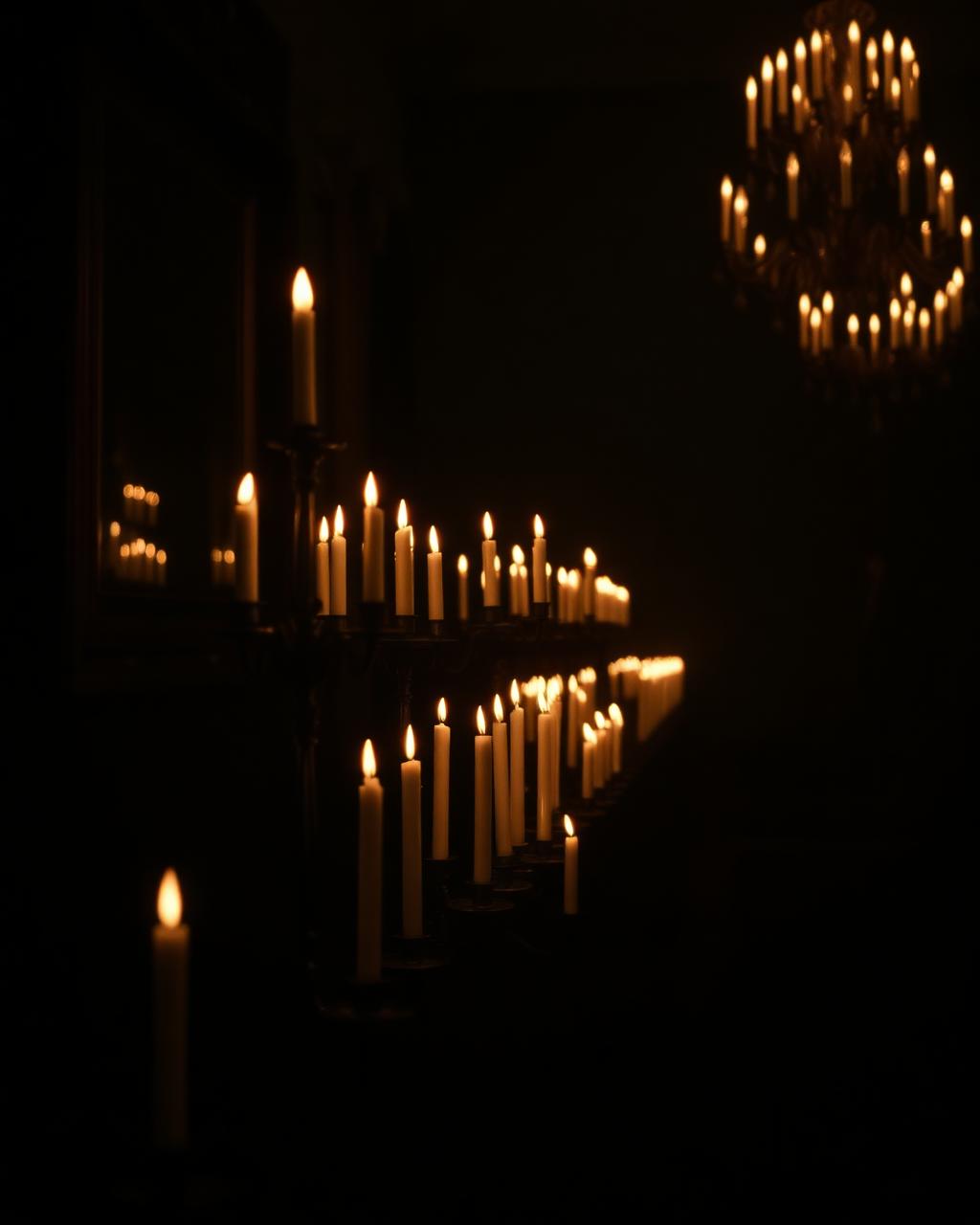
No lens existed that could do it. Kubrick's team eventually located a set of Zeiss Planar 50mm f/0.7 lenses — glass originally developed for NASA's Apollo lunar photography programme — and had them modified to mount on a Mitchell BNC camera, a process requiring the camera body itself to be rebuilt. The resulting interiors were shot by candlelight alone, sometimes with candelabra of dozens of candles as the only source in frame.
The look is unmistakable: an impossibly shallow depth of field, faces falling off into shadow within inches, warm pools of light with nothing beyond them. It changed the reference standard for period lighting permanently, and it is still the shot every cinematographer cites when they want to shoot a room by flame.
Candles do other work in film, too. In The Godfather, Gordon Willis lit Don Corleone's study so far down that critics nicknamed him the Prince of Darkness — flame and low practicals doing moral colouring rather than illumination. Ingmar Bergman used candlelight in Fanny and Alexander as the boundary between warmth and the cold austerity of the bishop's house. Horror discovered early that a handheld flame is the most efficient suspense device ever built, because it defines exactly how far you can see and moves the boundary with you.
There is a technical reason all of this works. Candle flame is roughly 1,800–1,900K — deeply warm, far below the 3,200K of tungsten — and it flickers, meaning the light on a face is never static for two consecutive frames. It renders skin more forgivingly than almost any artificial source, and it makes a still image feel alive.
Which is the same effect a candle has in an actual room. It is not just light. It is unrepeating movement, and the eye never entirely stops watching it.